Ontology
At a glance
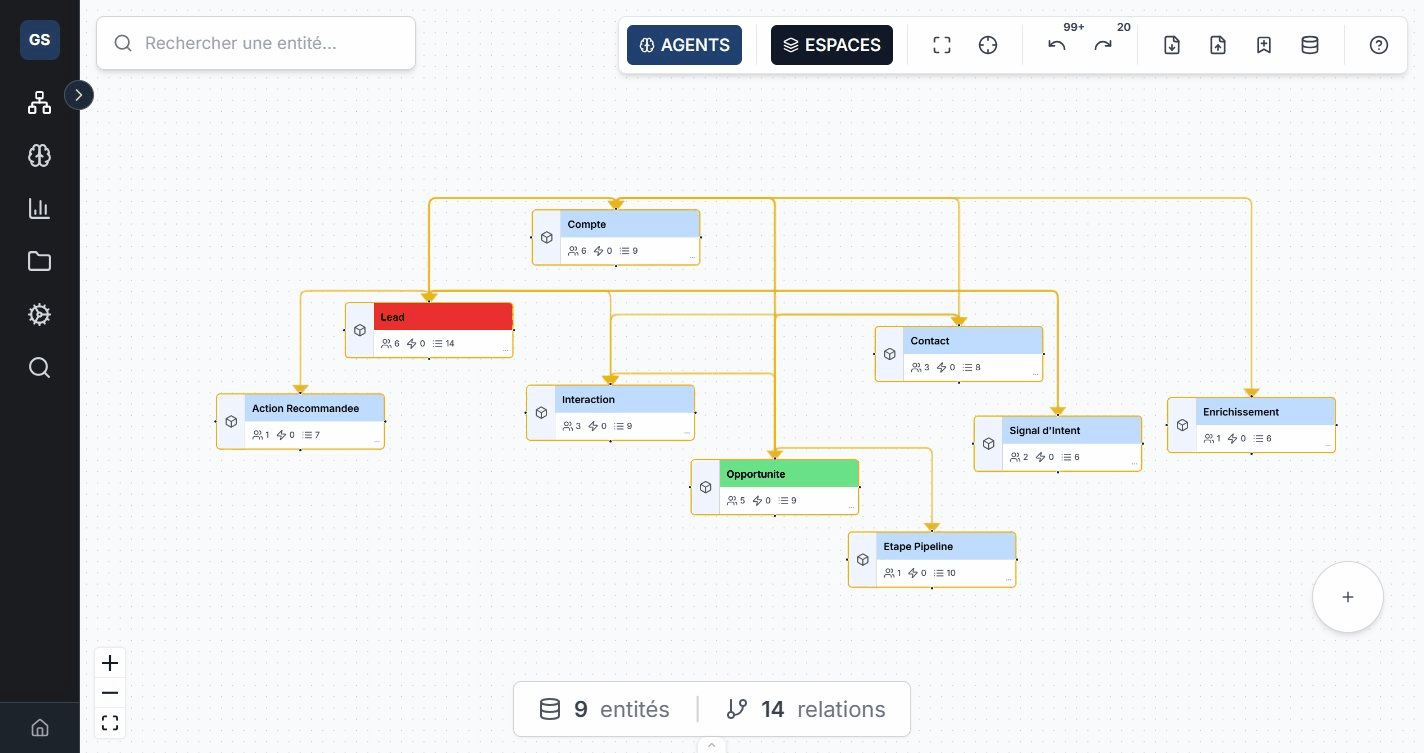
The ontology is the core of your business modeling. It lets you visually define the entities (concepts, objects, actors, processes) in your domain and the relations that connect them. It is your map of the territory: it structures information so that all your modules (search, workflows, AI agent) speak the same language.
Concrete example: in a supply chain, your entities might be "Supplier", "Product", "Warehouse", and "Order". Relations indicate that a Supplier "delivers" a Product, a Warehouse "stores" Products, and an Order "concerns" one or more Products.
What you'll do
- Create entities and link them on an intuitive visual canvas
- Define typed properties on each entity (text, number, date, reference, etc.)
- Organize your ontology by workspaces
- Navigate and search your entities quickly
- Automatically expose REST APIs for each entity
Key vocabulary
| Term | Meaning | Example |
|---|---|---|
| Entity | A concept or object in your business domain. | Supplier, Product, Client |
| Relation | A directed link between two entities. | Supplier → delivers → Product |
| Property | An attribute of an entity (data field). | name, email, unit_price |
| Space | A separate canvas to organize your entities. | "Supply Chain", "HR", "Finance" |
| Action | A triggerable operation on an entity. | "Send notification", "Launch workflow" |
Recommended paths
Modeler
Visual canvas to create and organize your entities and relations.
Spaces
Manage your different workspaces.
Navigator
Search, filter, and quickly edit your entities.
Links with other modules
- Knowledge Base: entities detected in your documents are automatically linked to your ontology. For example, if a contract mentions "ACME Corp", that mention is linked to the corresponding Supplier entity.
- LiveData: connect data sources (REST API, Webhook, Google Drive, etc.) directly to your entities to feed their properties in real time.
- Workflows: use the ontology and entity_lookup blocks to read and modify your entities from an automated workflow.
- AI Agent: the agent can explore your ontology, create entities, and answer questions about your model.
Expected outcome
Your business model is structured, navigable, and interconnected with other modules. Each entity exposes APIs, can be enriched by data sources, and is usable by the AI agent and workflows.
Need help?
Write to us: Support and contact.